Interpretive Capital
The quality of an institution’s read on reality: its ability to separate evidence from assumption, understand dependencies and revise its view as conditions change.

A theory of how institutions preserve control when consequential decisions must be made before certainty is available.
Judgment Capital is an institution’s accumulated ability to turn incomplete knowledge into coherent, high-consequence decisions under irreducible uncertainty.
AI is lowering the cost of analysis, modelling and plausible answers. That changes the competitive question. Access to intelligence matters, but it does not decide which commitments deserve to be made, which risks should be carried, or which future an institution should choose. Those remain questions of judgment.
A high-consequence decision is not defined simply by its size or visibility. It is consequential because it alters the future option set. It commits resources, affects relationships, changes the system around it and may close paths that cannot be reopened cheaply.
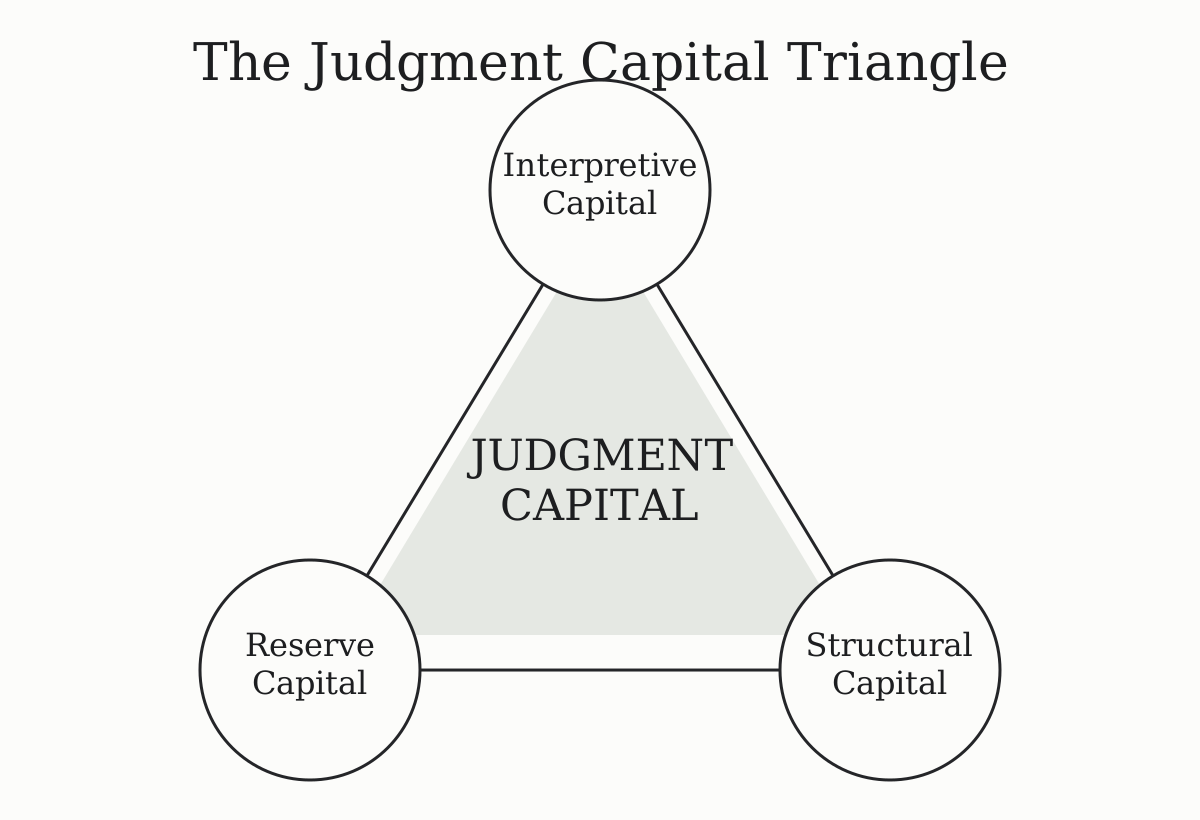
The three dimensions are distinct but inseparable. Judgment Capital appears only where all three are present at once.
The quality of an institution’s read on reality: its ability to separate evidence from assumption, understand dependencies and revise its view as conditions change.
The range of meaningful choices still open: time, liquidity, redundancy, relationships, alternative capabilities and room to act before events force a single path.
The durable means of converting understanding and options into commitment: clear responsibility, coordination, escalation, records of reasoning and institutional learning.
Clarity without leverage. The institution can see the situation but lacks the room to respond.
Flexibility without direction. Options are available, but their value cannot be judged.
Process that formalises confusion. The result is paralysis, over-commitment or bureaucracy.
Judgment Capital can increase after a poor outcome when the institution examines the reasoning behind its decision, corrects its assumptions and improves how it decides. It can also be depleted. Irreversible commitments often consume Reserve Capital quickly; interpretive models deteriorate when they stop being challenged; structures weaken when responsibility, coordination and learning become performative rather than real.
Avoncourt works on the conditions that strengthen Judgment Capital. Serendyp improves the institutional picture of reality and risk. Apollo provides interoperability for coordinated operations. Ntrepyd brings the actors and processes of an ecosystem into a workable model. Each capability is valuable on its own; their combined value appears where understanding, response and coordination must reinforce one another.
Explore the capabilities